The Devon Horse Show returns, in this weekend's Inquirer

Saturday, May 25, 2013


In which I write of my long love for this show, my gratitude for clop and bray.

I'll be posting photos of the show on this blog in the days to come.

I will also be posting news of an incredible new novel—Asunder, by Chloe Aridjis—due out this September and edited by the magical Lauren Wein. Look for my thoughts on this glorious work of art tomorrow.

Read more...

Small Damages Named to the Bankstreet Best Children's Books of the Year List

Friday, May 24, 2013

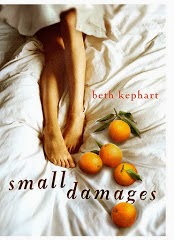
I am so grateful to Bankstreet for this honor—for including Small Damages among a tremendous list of novels written for younger readers.

Small Damages was named in the "Today" list and cited along with David Levithan's Every Day, John Green's The Fault in Our Stars, Tanita Davis's Happy Families, Aaron Karo's Lexapros and Cons, Martine Leavitt's My Book of Life by Angel, Deb Caletti's The Story of Us, and Kim Purcell's Trafficked, among other titles. It received a star for Outstanding Merit.

The entire list—of books for all ages, in all categories—can be found here.

Bankstreet does a lot of good in this world.

Read more...

new hope: the baby bird learns how to fly

Thursday, May 23, 2013


From the nest to the porch railing. A wild flutter of wings, and then up onto a thin branch of the Japanese maple. Five minutes later I found it out back.

The world now belongs to it, for a while.

New life. New hope.

Read more...

remembering my mother on her birthday, with chimes

Wednesday, May 22, 2013

video
Today my mother would have been eighty years old. We would have had a party for her.

Instead we each remember her in our own ways. Last night, my father, who keeps her grave so beautifully pristine, stopped by to show me the calla lilies he will take her today. She would have liked that so much. She would have been deeply moved by my father's constancy—always there, even when the rain starts to fall.

I will think of her listening to the chimes that play every day, the songs that float above. The flicker of butterflies. The call of birds.

Happy birthday, Mom. We miss you.

Read more...

Night Swim/Jessica Keener: Reflections

Tuesday, May 21, 2013

I took this photograph from a crowded Amtrak train, headed home to Philadelphia following a day spent in DC. I had gone to surprise my thirteen-year-old niece on her birthday, to see my sister and her family. Hidden within my bag of gifts was a single book, Night Swim, by Jessica Keener.

It's a book I'd bought months ago, a book that has always sat right there, on the top of my massive TBR. Jessica is what they call a Facebook friend, but she has always seemed, to me, far more substantial than that. When she comments on something, her words have gravitas. When she shares a moment in her life, it most often acts as a form of outreach, as an idea bigger than herself.

It was, then, with that sense of tugging familiarity that I began to read Night Swim, a debut novel for adults that has a teen at its center. Sarah Kunitz (lovers of poetry will recognize the power of her last name) is growing up in the 1970s, in a suburb of Boston, in a home of muted stresses. Her mother—beautiful, loving—occupies a buffer zone, needing pills to dull her aches, parties to bolster her confidence, a live-in maid to clear the dishes, more wine. Sarah's professor father, meanwhile, is strict and, in his own way, remote, losing control of his four children as time goes by. Sarah's mother almost dies, and a hush settles over the house. Then Sarah's mother does, indeed, die, and this hush is disturbing, tilted, suffused with a terrible drowning sound. Sarah is sixteen. She'll have to find her way. But the path ahead isn't marked.

Jessica writes quietly, forcefully, and with great knowing about remorse, wrong choices, brief releases, forever shadows. She writes with heart about a daughter's greatest loss—a mother. Just days before I read this novel, I had sat on a bench beside my own mother's grave, trying to tell her stories, wishing there was some way to get through. And so, on that train to and from DC, and then again in the quiet hours of this afternoon, I felt Jessica's own understanding of something we almost all come to face, in our lives. I felt, with this sadness, less alone.

From Night Swim, bought long ago, but perhaps read at the right time:
I turned over but repositioning my body didn't help at all. I turned back over. Mother's death became my life sentence, a different kind of imprisonment, and I realized that Eliot might be right about ghosts. This one had slipped inside me, pacing for public recognition, seeking that salve of music, a restless, circular longing for condolence and release.

Read more...

Dr. Radway and Dangerous Neighbors: a side-by-side review


Readers of this blog know that Dr. Radway's Sarsaparilla Resolvent is a story featuring a boy named William—a child of Bush Hill and Baldwin Locomotive Works, the brother to a young man murdered by a cop. William has lived in my imagination for many years. He was a primary character (but not the primary character) in my Centennial Philadelphia novel, Dangerous Neighbors. He rescues lost animals for a living. He matters to me.

Earlier today, I discovered that my friend Ed Goldberg, a librarian in the New York system, put Dr. Radway and Dangerous Neighbors side by side in a review. I love that he did this. I learned from his study. I'm deeply appreciative.

Ed's entire report can be found here, on his lovely blog, 2HeadsTogether. He ends his musings like this:
What both books do so well is describe one city, Philadelphia of the 1870s, although two different worlds. Both books delve into their main characters, William and Katherine, making them come alive. And both books use language as only Beth Kephart uses language.

It was a luxury reading the books one after the other, because it highlights the contrasts that otherwise would have been hidden. So, Dr. Radway’s Sarsaparilla Resolvent and then Dangerous Neighbors. The one-two punch in books.
Thank you, Mr. Ed. And thank you, Elizabeth Mosier, for the extraordinary note you wrote to me after you read the book through. No one can ever know just how much words like these matter to an author—especially in the case of this particular book.

I'll be talking about the research that fueled both books tomorrow, during the Week of Writing at Drexel University. If you're in the city I hope you'll join us, especially so that you can meet my most esteemed co-panelists, Rita Williams-Garcia and Eliot Schrefer.

Read more...

A Week of Writing at Drexel University: Join Us!

Monday, May 20, 2013

The crowd at Drexel University has put together an extremely interesting program for this very week, and I'm so happy to be part of it. On Wednesday, at 2 o'clock, I'll be joining Rita Williams-Garcia and Eliot Schrefer for a panel called Strange and Familiar Places in Young Adult Fiction (see below). But the entire week is full and rich, and I hope you'll double click on the poster above to find out more.

Strange and Familiar Places in Young Adult Fiction

Explores the complexities of conducting and incorporating research to create a sense of time and place in YA fiction. Attention to setting is crucial for any writer, but readers often overlook the breadth of historical, scientific, and philosophical inquiry that culminates in successful settings.  Panelists include: Beth Kephart, who will speak on the surprises and challenges of bringing 19th-century Philadelphia to life in Dangerous Neighbors (2010) and Dr. Radway’s Sarsaparilla Resolvent (2013); Eliot Schrefer, whoseEndangered (2012) depicts a bonobo sanctuary as war breaks out in the Democratic Republic of the Congo; and Rita Williams-Garcia, who will describe her research process in recreating the Black Power Movement in 1968 Oakland forOne Crazy Summer (2011) and its sequel in Brooklyn P.S. Be Eleven (2013).  Join us to discuss the craft of translating not just physical and geographical detail, but larger social and political contexts to the page.

2:00 pm – 3:20 pm
Lobby of Drexel University Recreation Center
Moderator: Dee McMahon
Panelists:
Beth Kephart, Eliot Schrefer, Rita Williams-Garcia


Read more...

my niece turns thirteen, and I was there.

Sunday, May 19, 2013

What a happy day we all had, in Washington, DC.
Happy birthday, beautiful Claire.
Have I mentioned how lucky Duke University (your dream university) will be to have you
...in five to six years' time?
Lucky indeed.

Read more...

royalty check: once again, I impress myself

Ladies and Gentlemen:
we're keeping it real out here in Beth land.

Read more...

scarlet tanager?

Saturday, May 18, 2013

outside, just now! the color of the sun at 5 AM this morning. this seems to be a scarlet tanager, though I'm not completely sure. but what a bird! what a bird!

Read more...

today's salsa lesson: to the challenges that sustain us

Friday, May 17, 2013


We read it all the time: We've got to challenge our brains to keep them fully engaged. We've got to challenge our brains to remain capable.

I'm particularly in need of capability-inducing challenges. I'm the sort of person who can remember the kind of ice cream I ordered at Dippy Don's as an eight-year-old but forgets the name of the person singing behind me in church (forgive me!). I can regale you with tales of memoirs loved and read (hundreds of them) but forget (just ask Libby Mosier) what tense I used for my own first young adult novel (past tense, in case you are wondering; I just checked).

I work to stave off my own decline by giving myself impossible things to do. Reading that is above my comprehension level (hey, that isn't hard). Pottery (because I'm a lifelong craft-o-phobe). And, as most of you know, ballroom dance.

This past week—my head full of too many things (and aching, too)—I was close as I have ever come to canceling the lesson. Just. No. Time. But then, in a hurry, we went. (So much of a hurry that I forgot my dance shoes, because no, we girls don't do salsa in pink Gap slippers—and yes, what does this tell you? My memory is slipping.)

Here's me with a migraine dancing with Scott, our instructor at DanceSport—videotaped so that my husband and I wouldn't forget the steps the second we left the studio. It's not pretty. The shoes are all wrong. I mess up.

But I'm keeping some blood flowing to my brain. And especially when it feels that we don't have any time for that, it's precisely what the doctor ordered.

To the challenges that will sustain us.


Read more...

Are MOOCs really the future of academic discourse?

Thursday, May 16, 2013


Not along ago, my friend Trey Popp wrote a thought-provoking piece in the Pennsylvania Gazette about MOOCs—massive open online courses. Trey enrolled, he persevered, he researched, he wrote. He made us think about the future of education.


MOOCs again take center stage in this week's issue of The New Yorker, where Nathan Heller asks, Has the future of college moved online? Under the guise of research, I stopped to read the piece in full. To think again about a topic that, in many ways, unnerves me.

MOOCs can, of course, be wonderfully supplemental; I've eyed a few courses myself. It can provide, for many, access to ideas and knowledge that simply didn't exist (for those many) before. There are plenty of barriers that get thrown down in the path of those wanting to learn—financial, physical, geographic—and for these hundreds of thousands, millions, even, a MOOC can be life raft material. It can equalize. It can secure.

But as a teacher in a small, crowded classroom on the University of Pennsylvania campus, as a mere adjunct who learns, time and again, that it's not the material I obsessively prepare that matters most, but the spontaneous combustion inside the teaching moment, I worry that the MOOC concept—taken too far, taken to unwarranted extremes—will slowly diminish that which I value most, and what my students (ask them) value, too.

The errant conversation. The tangential. The nonlinear. The relationships—real, non-crowdsourced—that build over time. In my classroom, I watch the postures and faces of my students. I see what they are hiding behind or wanting to express or struggling through. I show up early because I know that one, at least, will be showing up early, too—not to talk about the course, per se, but to talk about the bigger things that they are working through. Private and personal things. Internet aversive things. Nothing they'd ever want another soul to "like."

I teach memoir and literary profile. My students write weekly, read books, are read to. They do the work, and they grow as writers, but what matters perhaps even more is how they grow as people. How, through the writing work, they come to know themselves and broaden the way they think about others. How they allow language to release them, even relieve them. My students enter the room as strangers to one another other, and whether they are Wharton enrolled or bioengineers, future veterinarians or English professors, super geniuses who have essentially skipped through school or students from other lands just learning English, they forge a community that would not exist without the scratched table, the box of cookies, the breeze blowing through the velvet curtains.

All the while I'm learning, too. I'm forging the same life-long bonds. Taking the train to NYC to attend the engagement party of a recent graduate. Sending love to a once student/new mom. Helping students from two years ago publish today. Figuring out how I can get to New Orleans to see my Katie G before she heads to medical school. Writing about my Leah (above) and her own ambitions with children in the Philadelphia Inquirer. Writing recommendation letters and whispering in people's ears.

I do these things—I love to do these things—because my students are real to me, because I know them, because I've watched them, because I've given them room to be not just their academic selves, but their whole selves, because they have become my second family. They are, by and large, young. They are one person each on a large urban campus. They're struggling with others or struggling with themselves, and it means a lot to them (again, I say, ask them) that someone on that campus knows their name, or notices that they're absent, or sends an email:You can do better. Try again.

MOOCs, well managed, can do a lot of good. But let's make sure, as the future of education unfolds, that that other kind of good—that essential, human good—is not ultimately de-valued. Let's not forget what we have the responsibility to teach (good judgment, quiet reflection, attention to others, attention to one's self), along with the terms, the forms, the structures.

Read more...

Be here right now. (My husband talks me down from the cliff.)

Wednesday, May 15, 2013

"But I keep letting people down," I was saying, to my husband, who was listening. "I do my best to be where I should be, to give back to those who have given to me, to do my job, my ever-expanding job, but even so, I'm late, I'm behind, I'm absent, my friends are wondering if I'm in fact a friend."

"I haven't had my father for dinner."

"I missed a reading tonight."

"I had to say no to four kind offers."

"I'm behind and I'm behind."

I am forever walking around, I said, (imploringly), feeling some kind of version of incomplete. Feeling every kind of version of lousy. I am walking around with all kinds of failure walking after me.

My husband looked at me. He listened. There was that flick of impatience in his eyes.

"Here's what you are forgetting," he said. "You are here. Right now.

"Be here. Right now."


Read more...

Maria Semple reflecting on first drafts, hard work, and simplifying/sustaining choices


So enamored was I of Maria Semple's Where'd You Go, Bernadette, that I went on a hunt for Maria Semple conversations. Here she is reflecting on her first novel with words of great wisdom for all of us who sit down and try to do this work.

Read more...

Where'd You Go, Bernadette: Reflections on Maria Semple's novel and Anxiety Attacks

Tuesday, May 14, 2013

I downloaded Where'd You Go, Bernadette, a novel by Maria Semple, months ago. Last October, if you want to know the truth, when I thought my life could still make room for books.

Just before we were out the door for our weekend visit with our son, I remembered that the book was idling on my iPad and grabbed the gizmo. iPad books are particularly effective in early morning hours in hotel rooms when you really don't want to wake your husband, but you can't sleep, either. Before the crack of dawn, in a Marriott, I started in on Bernadette.

This is the story of an imploding, MacArthur-winning architect (Bernadette) in a saturated town of too-many five-point intersections (Seattle) who has a TED talk star of a husband employed by Microsoft. It is the story of gossiping neighbors, mud slides, cruel interventions, and a very smart little girl who loses her mother and hopes that the fragments she assembles (email correspondence, letters, documents) will help her right her world.

It's satire. It's funny. It hurts. It is complex and sophisticated. It gets a little crazy and perhaps (for a few pages) self indulgent. And then it rights itself. I call this kind of risk-taking novel heroic. I marvel at the fluidity of the prose, despite Semple's calculated choice to tell her story in spliced segments.

I recommend.

I always quote from books I've liked, to help give the readers of this blog a sense of what they might be in for. Typically I choose passages for their literary spectaculariness. Today I choose the piece below because when I read it, late today, after 36 hours of intense work on no more than 1,600 words (1,600 words!!!), I cried for the precision of these sentences.

This is, indeed, how an anxiety attack feels. I know. Many nights of many weeks, I know for absolute sure. Sometimes the only thing that can save me is the face of my son or the garden outside my door.

Panic, as explicated by Maria Semple:

... Even sleeping makes my heart race! I'm lying in bed when the thumping arrives, like a foreign invader. It's a horrible dark mass, like the monolith in 2001, self-organized but completely unknowable, and it enters my body and releases adrenaline. Like a black hole, it sucks in any benign thoughts that might be scrolling across my brain and attaches visceral panic to them. For instance, during the day I might have mused, Hey, I should pack more fresh fruit in Bee's lunch. That night, with the arrival of The Thumper, it becomes, I'VE GOT TO PACK MORE FRESH FRUIT IN BEE'S LUNCH!!! I can feel the irrationality and anxiety draining my store of energy like a battery-operated racecar grinding away in the corner. This is the energy I will need to get through the next day. But I just lie in bed and watch it burn, and with it any hope for a productive tomorrow. There go the dishes, there goes the grocery store, there goes exercise, there goes bringing in the garbage cans. There goes basic human kindness.

Read more...

A Library Journal Star for Handling the Truth

.Kephart, Beth. Handling the Truth: On the Writing of Memoir. Gotham Bks. Aug. 2013. 224p. ISBN 9781592408153. pap.
$16.
COMM
National Book Award finalist for A Slant of Sun, one of her several memoirs, Kephart (creative nonfiction, Univ. of Pennsylvania) has composed a gorgeous meditation on memoir. The author has achieved what few do in the crowded field of writing guides: she has created a work of art simply by reflecting on her own art—the writing and teaching of memoir. In four eloquent parts, Kephart introduces readers to the basic principles of memoir construction, suggests many writing prompts for navigating memories, and discusses the issues of describing living relatives and friends and of striving for accuracy. The book’s highest value lies in the author’s long experience with the memoir genre and its students. She writes with the same lyricism found in her own works and offers here passionate encouragement for would-be memoir writers to embrace truth and empathy, mystery and exploration. Drawing from classroom and personal examples, Kephart introduces readers to the delicate balance that creates the most honest and accomplished memoirs. An appendix of suggested memoirs for reading, grouped by category with generous annotations, is included.
VERDICT Highly recommended for anyone interested in the anatomy of a successful memoir and for all writers of literary nonfiction.—Stacey Rae Brownlie, Harrisburg Area Community Coll. Lib., Lancaster, PA


Enormous gratitude to Stacey Rae Brownlie. Thank you for your generosity. 

Read more...

Looks like I'm going to the BEA: Thanks so much to everyone who voted for Small Damages as the Best Young Adult Novel of 2012, in the Armchair BEA Awards

Monday, May 13, 2013

Truly, truly unbelievable. Truly impossible, without all of you. Thank you!!!!! to those who nominated Small Damages for this first annual award. Thank you to those who nudged it toward the win against two truly special artists, John Green and CJ Redwine. Thank you to those who make the Armchair BEA possible each year. I can't even imagine how much time and effort you Armchair BEA creators and coordinators put into this program. You have full-time jobs and responsibilities. We are lucky to have them in our lives. I am especially lucky.

Looks like I'll be going to the BEA after all, to accept the honor.

Wow.

Read more...

to my beautiful students on graduation day

You have inspired me, taught me, blessed me. You go into the world as bright lights at a time when the world needs a cure.

You carry my love forward—and my faith in you.

Congratulations and always,

Prof

Read more...

spending the weekend with my son; and words I once wrote, discovered by another

Sunday, May 12, 2013

We arrived just ahead of a massive storm. Ran through thinning rain drops. Settled down, then walked some more, and last night had a meal at a restaurant of his choosing. I took this photograph just as the storm was lifting. That's the Freedom Tower, fast becoming the western hemisphere's tallest building.

Today was glorious—a morning spent walking the quiet streets of SOHO, taking photos at the front doors of places we love, talking.

Children grow up. That's what they do. And when they are happy—when they have built their own lives, when they have made their own choices, when they show us their 'hoods and their homes—we are old and young in the same vast moment.

A happy day to all of you—no matter who you are or where your life has taken you.

And thank you to Melissa Middleman Firman, who discovered my words here alongside the words of truly great people. I often don't know what I'm doing standing in the same room as some of my heroes and heroines. I certainly don't know what to wear to the party. But I'm glad I was invited.

Read more...

in which Beth makes use of her pottery experiment

Saturday, May 11, 2013

and grows ever more determined to do better next time.

Read more...

my garden was in desperate need of me

Friday, May 10, 2013


All spring long I've looked outside my window despairing as the yellow weeds and the puffy weeds and the violet verticals choked my planned things in. I am a gardener. I love the things that grow. I have not been able to save my private world from the havoc of unwanted things.

Today was long; no need to list. And I still have things to do. Still, after seeing that the tree peony is already blooming without the benefit of contextual care, I literally ran from my car when I got home, threw my purse on the porch, and knelt down to tear away at the weeds.

I'm only a third done. It's ragged out there. But this is a portion of my paradise.

I need to take better care.

Read more...

My friends, my son, Patricia McCormick, Jan Shaeffer, my brother, Philadelphia: the day that was

Thursday, May 9, 2013


Yesterday: Work on a new client project—a wonderful new client project. I needed to be very still, and think. And then the kind surprise of the Armchair BEA nomination, which had me laughing over the preposterous oddness of it, and so grateful for the support of friends. And then a run to the train station beneath rain clouds, a serendipitous conversation with the poet Catherine Staples (now releasing her first book), a rainbow over the city, and a dash to the University of Pennsylvania campus, to return a nearly overdue book. The campus was as quiet as I had ever seen it. The only noise the noise of reunion tents being hammered into place.

From the campus I flew beneath blue-ing skies down Walnut Street to Tavern on the Green, the bar where my son placed his bets on the college basketball tournament several weeks ago. That son, whose actual job involves making very smart decisions about things that can't be entirely predicted, happened to win. Guessed every outcome correctly, earning the prize of $250, three crisp bills that had to be collected in person. Since this boy is now a New Yorker, the collection privilege was all mine. I slipped down the Tavern stairs (breathless and damp). Announced my intention. "I am J's mother," I said—the most important thing I'll ever be, no matter how old he insists on becoming. I was rewarded with an envelope that I will hand deliver this weekend when I see my handsome, so happy son.

But I digress. For now I was running again, back up Walnut, and north, to a restaurant my friend Jan Shaeffer had recommended, a place called A Kitchen. Jan, I'd said, a really important and wonderful person is coming to town and it's so necessary that we meet at the right place.

(Jan, who leads St. Christopher's Foundation for Children, knows EVERYthing, and I often ask her to tell me more.)

Jan, you were right. The meal was innovative; it was perfection. And the company—well, how do I even talk about Patricia McCormick, who is gorgeous inside and out. Greatness is only partially what someone can do, what someone has produced, and anyone who has read this blog, or listened to me talk, or read my Publishing Perspectives interview with Patty, or read my New York Times review of Joyce Carol Oates' new book (where of course I talked about Patty), knows that I think Patty's work spells greatness, that I think her work endures. But even if Patty had never written or published a word, her greatness would be transparent. She is breadth and depth. She asks, and she listens. She stands beneath the dark skies, shining. She leaves you slightly off balance.

To the skies that drizzled, then cleared. To rainbows. And to my brother, with whom I spoke by phone while watching the trains glide by ahead of midnight.

This afternoon I'll be honoring another friend, the very important Mike Yasick, whose red pants and enormity of soul I remembered here. We lost Mike far too soon in March, and this evening he is being honored by his former employer (and my client) Shire at the Boys and Girls Clubs of Philadelphia's Winemaker's Dinner. The Mike Yasick Literacy Center at the Shane Victorino Nicetown Boys and Girls Club is being inaugurated this evening. I am bringing every YA book I've ever written, and signing them to Mike.

In perpetuity.


Read more...

Please Vote: Small Damages named to Best Young Adult in Armchair BEA List!

Wednesday, May 8, 2013

This is sort of amazing to me (sort of! who am I kidding?) but Small Damages has just been named to the Armchair BEA Central Best of 2012 list, along with The Fault in our Stars and Defiance. I'm pretty darned sure this is the first time my book has ever been mentioned in the same breath as the work of John Green or CJ Redwine, and, well, yes, of course I'm the gonzo underdog here, but...> It would be so cool if you voted. It just would be so cool.

You can vote for this category and many others here. Voting ends May 13. 

I am so, well, grateful! Truly grateful. Is there another word?

Read more...

I had been waiting for a sign. It came.


Read more...

  © Blogger templates Newspaper II by Ourblogtemplates.com 2008

Back to TOP